European Capital Coats of Arms — 51 Capital City Emblems & Heraldry
Quick answer: The European Capital Coats of Arms dataset is a free GeoJSON point layer mapping 51 European capitals with their official civic crests, Wikimedia SVG/PNG links, and historical heraldic notes.
About this dataset
GeoJSON point dataset mapping 51 European capital cities with their official coats of arms, civic crests, Wikimedia SVG/PNG assets, and historical heraldry.
The European Capital Coats of Arms dataset maps 51 sovereign and regional capital cities across Europe with their official municipal crests, heraldic emblems, Wikimedia SVG links, and 330px PNG thumbnail renders. Each capital point pairs precise geographical coordinates with rich heraldic symbolism dating back to antiquity and the Middle Ages — from London's St George's Cross and dragons and Paris's silver vessel with the motto 'Fluctuat nec mergitur', to Rome's imperial SPQR banner, Berlin's heraldic bear, and Athens' Athena Parthenos seal. Ideal for cultural geography, historical GIS, educational cartography, and heraldic visualization.
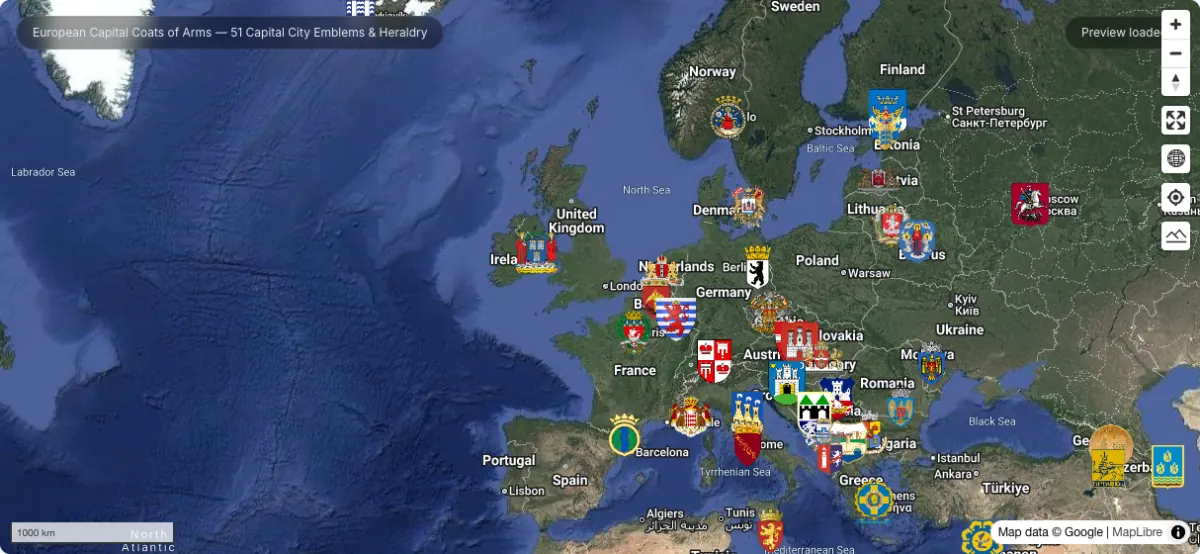
Actual dataset map screenshot; map and basemap credits are shown in the image. Captured 30 September 2026.
Historical Heraldry of Major European Capitals
European municipal heraldry reflects centuries of medieval charters, patron saints, royal allegiances, and civic resilience. Here are the historical origins of key capital city emblems:
Paris (France) — The Scilicet Ship
Motto: 'Fluctuat nec mergitur' · Origin: 12th Century
Depicts a silver sailing vessel (Scilicet) floating on stormy sea waves below royal golden fleurs-de-lis. Originates from the powerful medieval Guild of Water Merchants (Marchands de l'eau) who controlled Seine trade. The Latin motto means 'She is tossed by the waves, but does not sink'.
London (United Kingdom) — St George & Dragons
Motto: 'Domine dirige nos' · Origin: 1381
Features the red Cross of Saint George on a silver shield with the upward-pointing red sword of Saint Paul in the canton. Supported by two winged heraldic dragons, reflecting London's ancient municipal liberties with the Latin motto meaning 'Lord, guide us'.
Rome (Italy) — SPQR & Gold Cross
Motto: 'Senatus Populusque Romanus' · Origin: Ancient Roman Era
A classic French-shaped red shield charged with a golden Greek cross and the ancient diagonal letters SPQR (The Senate and People of Rome), crowned by an eight-towered golden mural crown honoring the Eternal City's imperial heritage.
Berlin (Germany) — The Berlin Bear (Berliner Bär)
Heraldic Symbol: Bear Rampant · Origin: 1280
A black bear rampant with red tongue and claws on a silver shield, surmounted by a five-towered golden mural gate crown. First recorded on a guild seal in 1280, the bear is a canting pun on the name Berlin (Bär = bear in German folk etymology).
Madrid (Spain) — The Bear & Strawberry Tree
Symbol: 'El Oso y el Madroño' · Origin: 1222
Depicts a brown bear rearing on its hind legs to eat fruit from a strawberry tree (madroño) on a silver field, surrounded by an azure border with seven silver stars representing the Ursa Major constellation. Granted in 1222 by King Alfonso VIII.
Prague (Czechia) — Bohemian Fortifications & Lions
Motto: 'Praga Caput Rei publicae' · Origin: 1462
Shows three golden towers rising over open silver city gates with a raised golden portcullis, from which an armored knight's arm brandishes a silver sword. Flanked by two double-tailed silver Bohemian lions granted by Emperor Frederick III.
Vienna (Austria) — Imperial Double-Headed Eagle
Symbol: Kreuzschild & Reichsadler · Origin: 1278
A silver cross on a red shield (Kreuzschild) displayed on the breast of the double-headed black imperial eagle (Reichsadler) of the Holy Roman Empire, adorned with golden halos and imperial crowns.
Amsterdam (Netherlands) — Three St Andrew's Crosses
Symbol: Keizerskroon & Saltires · Origin: 1489
A red shield with a black vertical pale charged with three silver Saint Andrew's saltire crosses, supported by two golden lions and topped by the Imperial Crown of Austria (Keizerskroon) bestowed by Holy Roman Emperor Maximilian I in 1489.
Athens (Greece) — Athena Parthenos Seal
Symbol: Goddess of Wisdom · Origin: Classical Antiquity
Features the profile bust of the goddess Athena Parthenos wearing her crested Attic helmet, circled in gold with the Greek inscription 'ΔΗΜΟΣ ΑΘΗΝΑΙΩΝ' (Municipality of the Athenians), celebrating the cradle of Western democracy.
Dublin (Ireland) — Three Burning Castles
Motto: 'Obedientia Civium Urbis Felicitas' · Origin: 1229
Three silver castle towers with flames issuing from their battlements on an azure shield. The Latin motto translates to 'The obedience of the citizens is the happiness of the city', granted by King Henry III in 1229.
Stockholm (Sweden) — Saint Eric (King Eric IX)
Symbol: Patron Saint of Sweden · Origin: 1376
The crowned golden head of King Saint Eric (Eric IX, who reigned 1156–1160 and became Sweden's patron saint) set upon a royal blue azure field, used continuously on Stockholm city seals since 1376.
Kyiv (Ukraine) — Archangel Michael
Symbol: Heavenly Protector · Origin: 16th Century
The Archangel Saint Michael in silver armor and blue tunic holding a flaming sword of justice in his right hand and an eight-pointed cross shield in his left, with a golden halo against an azure background.
Bern (Switzerland) — Zähringen Walking Bear
Symbol: Canting Heraldry · Origin: 1191
A black bear with red tongue and claws striding up a golden bend on a field of red. Honors the founding of Bern in 1191 by Duke Berthold V of Zähringen, who according to legend named the city after the first animal slain in the forest (Bär).
Edinburgh (Scotland / UK) — Edinburgh Castle on the Rock
Motto: 'Nisi Dominus Frustra' · Origin: 14th Century
The triple-towered Edinburgh Castle perched on a dark rugged rock with open portal and golden portcullis, supported by a maiden and an anchor, bearing the Scottish Latin motto from Psalm 127: 'Except the Lord build the house, they labour in vain'.
Vatican City / Holy See — Keys of Heaven & Tiara
Symbol: Petrine Keys · Origin: Biblical / Papal Antiquity
The crossed Keys of Saint Peter (one gold symbolizing spiritual authority, one silver symbolizing temporal authority) bound by a red cord beneath the triple Papal Tiara (Triregnum), referencing the Gospel of Matthew 16:19.
Lisbon (Portugal) — Saint Vincent's Ship & Crows
Symbol: Maritime Saint Translation · Origin: 1173
A golden sailing ship on green sea waves guided at bow and stern by two black crows. Commemorates the legendary sea translation of the relics of Saint Vincent of Saragossa to Lisbon in 1173 under King Afonso Henriques.
Warsaw (Poland) — Syrenka Warszawska (Warsaw Mermaid)
Symbol: Guardian of the Vistula · Origin: 1390
A crowned mermaid with twin fish tails wielding a golden curved sabre and round shield on a field of gules (red), symbolizing the protective guardian spirit of the Vistula River and the Polish capital.
Budapest (Hungary) — United Buda & Pest Castles
Symbol: Saint Stephen's Crown · Origin: 1873
Combines the one-gated castle of Pest on a red field and the three-gated castle of Buda on a blue field, separated by a silver wavy bar representing the Danube river, crowned by the Holy Crown of Saint Stephen and supported by a golden lion and griffin.
Complete Heraldic Registry of 51 European Capitals
Summary table of all 51 capital cities included in the dataset, listing their core heraldic motifs, historical origins, and links:
| Capital City | Country | Heraldic Motif / Symbol | Key Historical Significance | Reference |
|---|---|---|---|---|
| Tirana | Albania | Clock Tower & City Gate | Red-black shield with double-headed Albanian eagle, Ottoman clock tower, and castle gate | Wikipedia: Tirana |
| Andorra la Vella | Andorra | Mitre & Feudal Pales | Combines the bishop's mitre of Urgell with the red and gold stripes of Foix and Catalonia | Wikipedia: Andorra la Vella |
| Yerevan | Armenia | Lion of Erebuni | Crowned Urartu golden lion holding a scepter atop an ancient Erebuni pedestal (782 BC) | Wikipedia: Yerevan |
| Vienna | Austria | Imperial Double Eagle | Silver cross on a red shield (Kreuzschild) mounted on the Holy Roman Imperial Eagle | Wikipedia: Vienna |
| Baku | Azerbaijan | Three Golden Flames | Three eternal flames rising from Caspian Sea waves, crowned by a gear and maritime anchor | Wikipedia: Baku |
| Minsk | Belarus | Assumption of Mary | Virgin Mary in blue and red robes escorted by angels and cherubim, granted by royal charter in 1591 | Wikipedia: Minsk |
| Brussels | Belgium | Archangel Saint Michael | Saint Michael in gold armor slaying the devil dragon on a red field of gules (1290) | Wikipedia: Brussels |
| Sarajevo | Bosnia and Herzegovina | Triple Castle & Latin Bridge | Three-towered fortress over the Miljacka River and arched stone bridge, symbolizing city defense | Wikipedia: Sarajevo |
| Sofia | Bulgaria | Mural Crown & Four Quarters | Ulpia Serdica, Vitosha Mountain, Apollo's temple, and golden Bulgarian lion; motto: 'Raste, no ne staree' | Wikipedia: Sofia |
| Zagreb | Croatia | Gradec Fortress & Star | Silver fortress on a green hill with open golden gates under a golden star and crescent moon (1242) | Wikipedia: Zagreb |
| Nicosia | Cyprus | Venetian Lion & Bastions | Winged Lion of Saint Mark within the 11-bastion Renaissance Venetian fortification outline | Wikipedia: Nicosia |
| Prague | Czechia | Bohemian Gates & Knight | Three golden towers over open silver gates with an armed knight, supported by two Bohemian lions | Wikipedia: Prague |
| Copenhagen | Denmark | Three Red Towers & Waves | Three red brick towers above blue sea waves with golden crescent and star, established in 1296 | Wikipedia: Copenhagen |
| Tallinn | Estonia | Three Danish Blue Lions | Three blue lions passant guardant on a golden shield with a maiden crest, from Danish rule in 1219 | Wikipedia: Tallinn |
| Helsinki | Finland | Boat Under Swedish Crown | Golden rowing boat (ruuhi) on blue waves beneath a royal Swedish coronet, granted in 1639 | Wikipedia: Helsinki |
| Paris | France | Scilicet Ship & Fleurs-de-lis | Silver vessel upon stormy waves with royal fleurs-de-lis; motto: 'Fluctuat nec mergitur' (12th Century) | Wikipedia: Paris |
| Tbilisi | Georgia | Cross & Royal Falcon | Round shield with Georgian cross, eagle, and pheasant referencing King Vakhtang's 5th-century founding | Wikipedia: Tbilisi |
| Berlin | Germany | Berliner Bär (Berlin Bear) | Black bear rampant with red tongue and claws on silver shield with five-towered mural gate crown (1280) | Wikipedia: Berlin |
| Athens | Greece | Athena Parthenos Profile | Golden profile bust of goddess Athena in crested Attic helmet encircled by 'ΔΗΜΟΣ ΑΘΗΝΑΙΩΝ' | Wikipedia: Athens |
| Budapest | Hungary | United Buda & Pest Castles | Two castles separated by the silver Danube river, united in 1873 under Saint Stephen's Holy Crown | Wikipedia: Budapest |
| Reykjavik | Iceland | Ingólfur's High-Seat Pillars | Two silver high-seat pillars (öndvegissúlur) on blue and silver sea waves (874 AD Norse settlement) | Wikipedia: Reykjavik |
| Dublin | Ireland | Three Burning Castles | Three silver castles with flames issuing from towers, with motto 'Obedientia Civium Urbis Felicitas' (1229) | Wikipedia: Dublin |
| Rome | Italy | SPQR & Gold Greek Cross | Gold Greek cross and the ancient Roman abbreviation SPQR on a red shield beneath a golden mural crown | Wikipedia: Rome |
| Pristina | Kosovo | Goddess on the Throne | Terracotta Neolithic figurine 'Hyjnesha në Fron' discovered at Tjerrtorja dating to 4000 BC | Wikipedia: Pristina |
| Riga | Latvia | Crossed Keys of St. Peter | City wall with open portal, crossed golden keys, golden cross, and two golden lions (1225) | Wikipedia: Riga |
| Vaduz | Liechtenstein | Princely Coronet & Tower | Silver and blue parted shield with red castle tower topped with the princely coronet of Liechtenstein | Wikipedia: Vaduz |
| Vilnius | Lithuania | Saint Christopher & Child Jesus | Saint Christopher wading across water carrying the Child Jesus holding the globus cruciger (1330) | Wikipedia: Vilnius |
| Luxembourg City | Luxembourg | Crowned Red Lion on Stripes | Red double-tailed lion rampant on ten silver and blue horizontal stripes (burely, 1235) | Wikipedia: Luxembourg City |
| Valletta | Malta | Knights Hospitaller Shield | Parted red and silver shield of the Order of Saint John of Jerusalem with a golden mural crown | Wikipedia: Valletta |
| Chișinău | Moldova | Golden Eagle & Aurochs | Blue eagle holding a golden cross in its beak with an ancient aurochs head on a red heart shield | Wikipedia: Chișinău |
| Monaco | Monaco | Grimaldi Red-White Lozenges | Lozengy argent and gules supported by two sword-wielding Franciscan monks; motto: 'Deo Juvante' (1297) | Wikipedia: Monaco |
| Podgorica | Montenegro | Silver Bridge & Battlements | Silver arched bridge over three blue river lines beneath two medieval fortress battlements | Wikipedia: Podgorica |
| Amsterdam | Netherlands | Three St. Andrew's Crosses | Red shield with a black vertical pale and three silver saltire crosses, topped by Emperor Maximilian's Imperial Crown (1489) | Wikipedia: Amsterdam |
| Skopje | North Macedonia | Stone Bridge & Kale Fortress | Ottoman Stone Bridge over the Vardar River beneath the Kale Fortress and snow-capped Mount Ljuboten | Wikipedia: Skopje |
| Oslo | Norway | Saint Hallvard with Millstone | Saint Hallvard holding three arrows and a millstone sitting on a lion throne, with patron border (1300) | Wikipedia: Oslo |
| Warsaw | Poland | Syrenka Warszawska (Mermaid) | Crowned mermaid wielding a golden sabre and circular shield on a field of gules (red, 1390) | Wikipedia: Warsaw |
| Lisbon | Portugal | St. Vincent's Ship & Crows | Golden ship on green sea waves guarded by two black crows (Saint Vincent translation in 1173) | Wikipedia: Lisbon |
| Bucharest | Romania | Saint Demetrius the New | Saint Demetrius in Roman legionary armor holding a spear and cross with an eagle and cross | Wikipedia: Bucharest |
| Moscow | Russia | Saint George Slaying Dragon | Saint George in silver armor with a blue cape spearing a black dragon on a red shield (14th Century) | Wikipedia: Moscow |
| San Marino | San Marino | Three Towers of Mount Titano | Three green mountain peaks topped with silver towers and ostrich plumes; motto: 'Libertas' (301 AD) | Wikipedia: San Marino |
| Belgrade | Serbia | White Fortress on Red Hill | White fortress towers with open gate over the Sava and Danube rivers with a Roman war galley | Wikipedia: Belgrade |
| Bratislava | Slovakia | Three-Towered Silver Castle | Red shield with a three-towered silver castle and open golden portcullis gate (1436) | Wikipedia: Bratislava |
| Ljubljana | Slovenia | Green Dragon on Castle | Green dragon perched upon a red castle tower over green hills (Jason and the Argonauts legend) | Wikipedia: Ljubljana |
| Madrid | Spain | Bear & Strawberry Tree (Madroño) | Brown bear leaning against a strawberry tree within an azure border of seven silver stars (Ursa Major, 1222) | Wikipedia: Madrid |
| Stockholm | Sweden | King Saint Eric IX | Crowned golden portrait of King Eric IX, patron saint of Sweden, on an azure field (1376) | Wikipedia: Stockholm |
| Bern | Switzerland | Zähringen Bear on Gold Bend | Black bear with red claws and tongue walking up a golden bend on red, founded in 1191 by Berthold V | Wikipedia: Bern |
| Ankara | Turkey | Hittite Sun Course Emblem | Hittite Sun Course symbol combined with the crescent moon and the silhouette of Atakule tower | Wikipedia: Ankara |
| Kyiv | Ukraine | Archangel Michael with Sword | Archangel Michael in silver armor with a flaming sword and cross shield on an azure background | Wikipedia: Kyiv |
| Edinburgh | United Kingdom | Edinburgh Castle on Rock | Triple-towered fortress on a dark crag with anchor and deer supporters; motto: 'Nisi Dominus Frustra' | Wikipedia: Edinburgh |
| London | United Kingdom | St George's Cross & Dragons | Cross of Saint George with the sword of Saint Paul, supported by two dragons; motto: 'Domine dirige nos' | Wikipedia: London |
| Vatican City | Vatican City | Keys of Heaven & Tiara | Crossed gold and silver Keys of Saint Peter beneath the Papal Tiara (Triregnum, Matthew 16:19) | Wikipedia: Vatican City |
How to download
- 1 Download the europe_capital_coats.geojson file directly from the link above.
- 2 Open the dataset in GeoDataViewer Studio or inspect the interactive map preview above.
- 3 Click any capital city point to view its official emblem image, Wikidata identifier, and Wikipedia article.
- 4 Export to Shapefile, KML, or GeoPackage for your desktop GIS or web cartography workflows.
FAQ
What does the European Capital Coats of Arms dataset contain?
It contains point features for 51 capital cities across Europe, including national capitals (Paris, London, Rome, Berlin, Madrid, etc.) and regional capitals (Edinburgh). Each record includes city name, country name, Wikidata QID, Wikimedia emblem filename, direct SVG vector URL, 330px PNG thumbnail URL, and Wikipedia article link.
How can I visualize the emblem images on an interactive map?
Open the dataset in GeoDataViewer Studio or GIS software that supports image property fields. The thumb_url property provides high-resolution 330px PNG images that can be rendered inside map popups, tooltip cards, or custom image markers.
What is the historical significance of European municipal heraldry?
City coats of arms in Europe developed during the High Middle Ages (12th–14th centuries) as symbols of urban autonomy, royal charters, merchant guild privileges, and patron saint protection. Many symbols—such as Paris's sailing vessel, London's sword of St Paul, Berlin's bear, and Rome's SPQR—have been continuously used for over 700 years.
Can I use this dataset for educational and commercial projects?
Yes. The GeoJSON file and geographical coordinates are provided freely by GeoDataViewer. The emblem images are hosted on Wikimedia Commons under Creative Commons or Public Domain terms (check individual Wikimedia links for exact attribution requirements).
How do I convert this GeoJSON dataset into Shapefile or GeoPackage?
Use the direct download button to download the GeoJSON file, then drop it into the GeoDataViewer converter tool (/geojson-to-shapefile/ or /geojson-to-gpkg/) to convert it to ESRI Shapefile, GeoPackage, KML, or CSV format in seconds.