Historic Battles of the World — 25,000+ from Wikidata
Quick answer: Download more than 25,000 geolocated historic battles from Wikidata as a single GeoJSON file, complete with dates and parent wars, and view them on an interactive map.
About this dataset
Over 25,000 geolocated historic battles from Wikidata, each with its date and the parent war it belongs to.
This dataset maps every battle recorded in Wikidata (instance of Q178561) that has identifiable coordinates — more than 25,000 armed engagements spanning antiquity to the modern era, from minor skirmishes to decisive turning points. Each point carries the battle name, its Wikidata entity, the date it was fought, and the parent war it belongs to, making it possible to trace how conflicts unfolded across geography and time. The data was extracted from Wikidata via the SPARQL query service and published as a single global GeoJSON file.
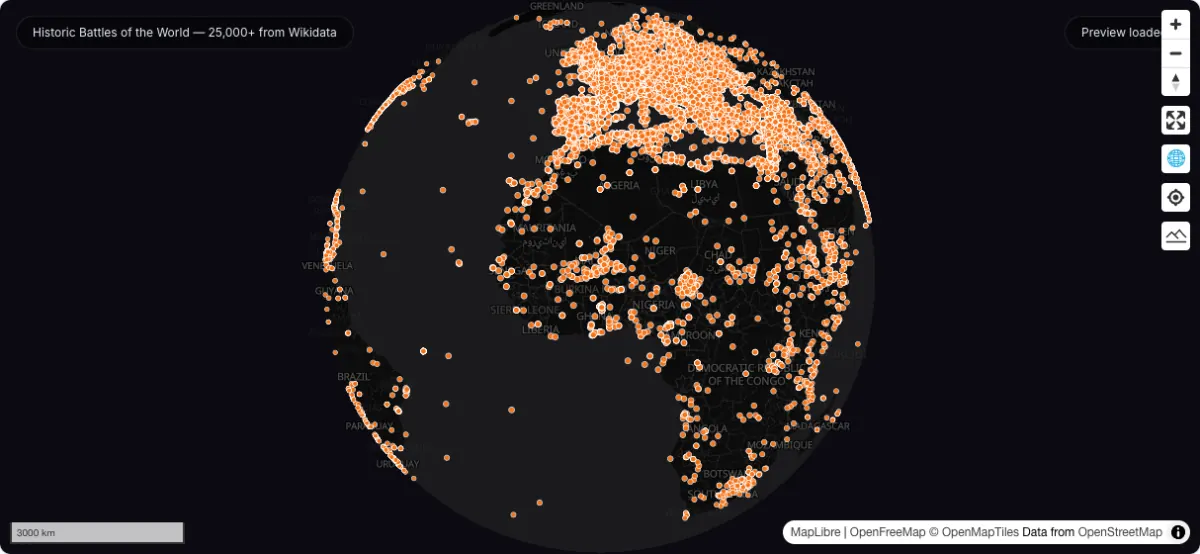
Actual dataset map screenshot; map and basemap credits are shown in the image. Captured 30 September 2026.
Famous battles in this dataset
Among the 25,000+ engagements are many of history's best-known battles. The dataset's densest wars by battle count are the American Civil War (607 battles), World War II (392), the American Revolutionary War (260), World War I (213), and the Eighty Years' War (209). Here is a selection of landmark encounters, each one a point you can find on the map:
Battle of Marathon
490 BC · First Persian invasion of Greece
The Athenian victory that ended the first Persian invasion of Greece; the runner's route to Athens gave the marathon race its name.
Battle of Thermopylae
480 BC · Second Persian invasion of Greece
Leonidas's rearguard of Spartans and allies held the coastal pass for days against Xerxes's advancing army.
Battle of Gaugamela
331 BC · Wars of Alexander the Great
Alexander's decisive defeat of Darius III that delivered the heart of the Persian Empire.
Battle of Cannae
216 BC · Second Punic War
Hannibal's double envelopment annihilated a Roman army roughly twice its size — still studied as a tactical masterpiece.
Battle of Hastings
1066 · Norman conquest of England
William the Conqueror's victory over Harold II ended Anglo-Saxon rule and reshaped the English state.
Battle of Crécy
1346 · Hundred Years' War
English longbowmen routed the French knighthood in the first great land battle of the Hundred Years' War.
Battle of Agincourt
1415 · Hundred Years' War
Henry V's exhausted army crushed a far larger French force on St Crispin's Day.
Battle of Lepanto
1571 · Ottoman–Venetian War of 1570–1573
The Holy League's galley fleet broke Ottoman naval dominance in the Mediterranean.
Battle of Sekigahara
1600 · Sekigahara Campaign
Tokugawa Ieyasu's triumph unified Japan and opened more than two centuries of Tokugawa rule.
Battle of Austerlitz
1805 · War of the Third Coalition
Napoleon's masterpiece against the Austrian and Russian armies, often called the Battle of the Three Emperors.
Battle of Trafalgar
1805 · Trafalgar Campaign
Nelson's fleet destroyed the combined Franco-Spanish fleet, sealing British naval supremacy for a century.
Battle of Borodino
1812 · French invasion of Russia
The bloodiest single day of Napoleon's Russian campaign, fought on the approaches to Moscow.
Battle of Waterloo
1815 · Waterloo Campaign
Napoleon's final defeat by Wellington and Blücher that ended the Hundred Days.
Battle of Antietam
1862 · American Civil War
The bloodiest single day in American military history, fought along Antietam Creek in Maryland.
Attack on Pearl Harbor
1941 · South-East Asian theater of World War II
The Japanese carrier strike that brought the United States into World War II.
Battle of Kursk
1943 · World War II
The largest armored clash in history and the last German strategic offensive on the Eastern Front.
How to download
- 1 Download the global battles GeoJSON file.
- 2 Open it in GeoDataViewer Studio to explore battles on an interactive map.
- 3 Use the attribute table to filter by parent war or date range.
- 4 Cite Wikidata (CC0) when reusing the data in research or visualizations.
FAQ
Where does the battle data come from?
Every battle is an entity in Wikidata tagged as an instance of battle (Q178561) with coordinates (P625) or a located-at place (P276) that itself has coordinates. The SPARQL query also pulls the battle date (P585, P580, or P582) and its parent war (P361).
How complete is the dataset?
Coverage mirrors Wikidata: well-documented battles — especially European, American, and East Asian engagements — are thoroughly represented, while coverage of other regions depends on how much battle documentation the Wikidata community has contributed. Expect more than 25,000 points with uneven density.
What attributes does each battle have?
Each point includes the battle name (subjectLabel), its Wikidata entity URI (subject), the date it occurred (date), and the parent war it belongs to (parentWarLabel) when Wikidata records one.
Can I filter battles by war or period?
Yes. Open the file in GeoDataViewer and use the filter panel to select a specific parentWarLabel value, or the timeline panel to animate battles chronologically.
Does the dataset include famous battles like Hastings, Waterloo, or Stalingrad?
Yes. Landmark battles from Marathon and Gaugamela to Hastings, Agincourt, Trafalgar, Waterloo, Antietam, and Kursk are all present as individual points with their dates and parent wars — see the 'Famous battles in this dataset' section above for a curated selection.